
Bitcoin Price Weekly Outlook
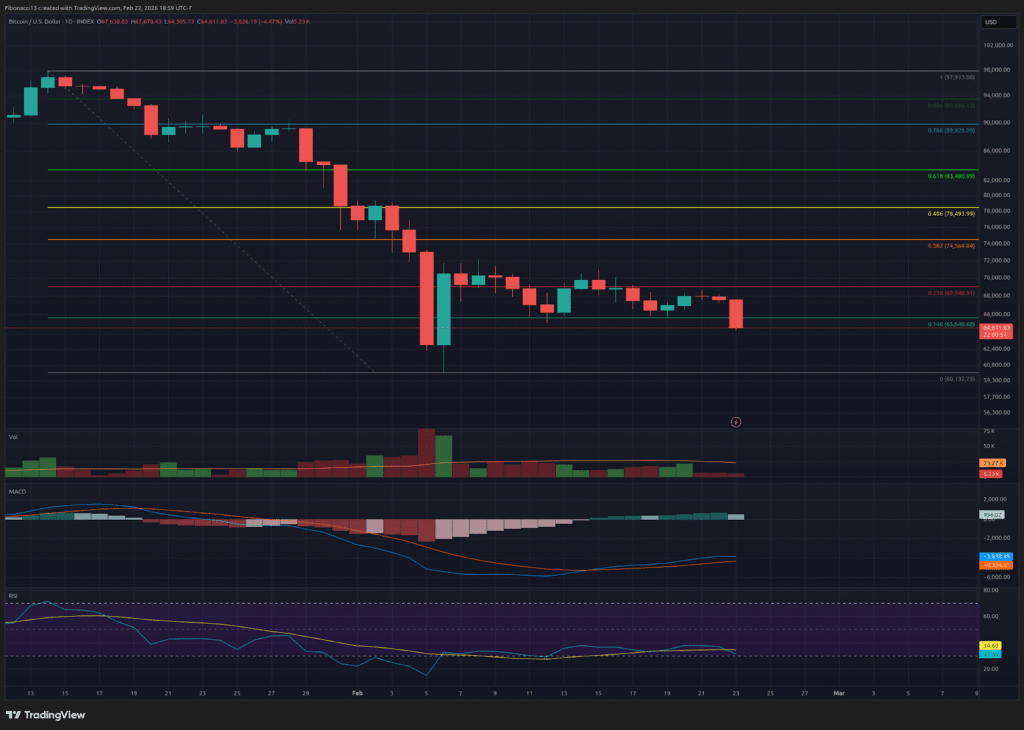
Bitcoin closed the week at $67,638, not a terrible close by any means. The support level at $65,650 has been holding for a few weeks now, but persistent selling pressure will likely pull it out this week. As of the time of this writing on Sunday night, the price of bitcoin is currently trading below this support level at $64,600. We should expect that price action will remain low this week and may threaten to break out of the $60,000 lows.
Key Support and Resistance Levels Now
There is still a chance that the $65,600 support level could hold if the price is able to close back above it, but it is highly unlikely at this point. $63,000 would be the last line for the bulls to avoid making a new low here. It is possible that $57,800 could hold a weekly close and provide a reversal, but I would not be surprised if the price moves well below this level first, dropping to $53,000. Closing the week below $57,800 opens a support zone at $42,000 to $44,000, which should be a good area for long-term support and a possible price reversal.
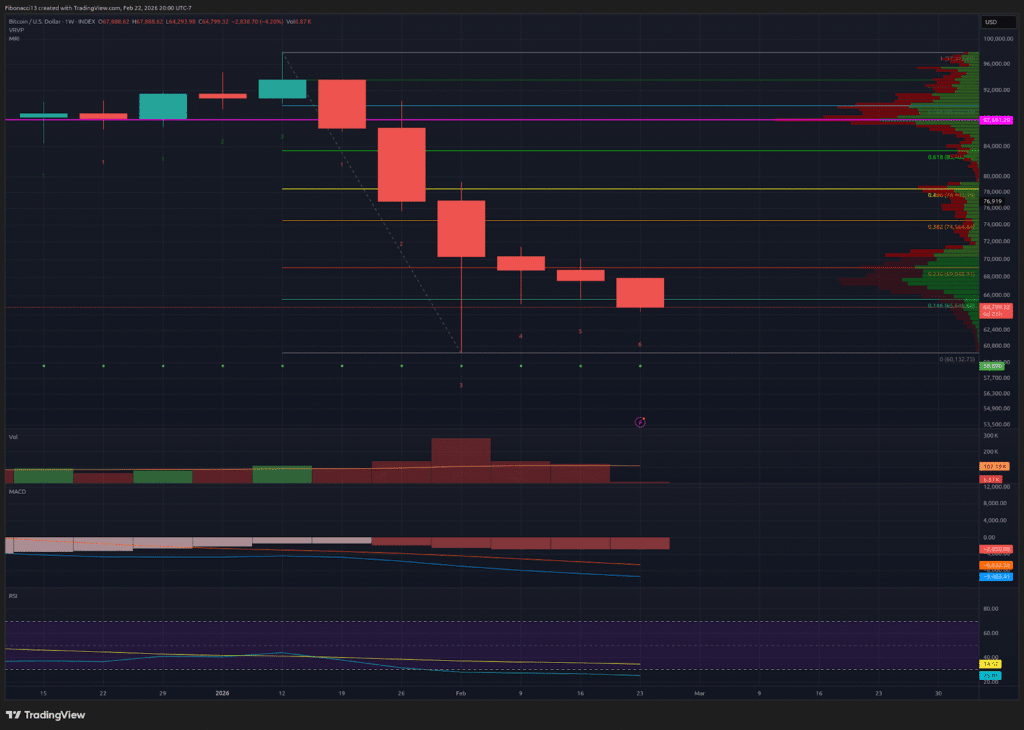
It almost feels like there is no point in providing resistance levels going into this week, given how price action has been. The price has been trying to hold on to this important support area, maintaining a weekly close above $67,000. If we finally lose this level, look for it to be long-term POC resistance on the volume profile now resting right there. $72,000 proved to be key resistance above. A close above $72,000 opens $74,500, then we have $79,000 resistance above that.
This week’s Outlook
As this week’s price action begins with a big drop on Sunday night, the outlook is very bleak this week. While the daily oscillators gave us hope for a pullback over the past few weeks, they seem to be turning upside down now. The RSI is currently below the 13 SMA, while the MACD appears to be heading for a cross below the zero line. Both of these signals, confirmed by daily closes, should lead to further declines.
Market situation: Very bearish – The weekly candle this past week was not much like last week, still weak, still strong.
Over the next few weeks
These bulls failed to generate any momentum after jumping from $60,000 three weeks ago. The weekly oscillators are still in bearish territory with no signs of reversal, indicating a continuation down. The MRI indicator is sitting at 6 red entering this week, which could suggest another four weeks of bearish price action ahead, unless the price is able to close above $77,000 this week. This would be a very unlikely outcome, to say the least. HODL on your hats!
Vocabulary Guide:
Bulls/Bulls: Buyers or investors do not expect the price to rise.
Bears/Bears: Sellers or investors are not expecting the price to go down.
Level of support or support: The level at which the price should hold for the asset, at least initially. The more support is touched, the weaker it is and the more likely it is to fail to hold the price.
Resistance or resistance level: As opposed to support. The rate is likely to decline the price, at least initially. The more resistance is touched, the weaker it is and the more likely it is to fail to hold the price.
Volume Profile: An indicator that shows the total volume of buying and selling at certain price levels. A point of control (or POC) is a horizontal line on this indicator that shows the price level where the highest trading volume has occurred.
SMA: Moderate Easy Walk. Average price based on closing prices in the specified period. In the case of RSI, it is the average strength indicator value over a specified period.
Oscillators: Technical indicators vary over time, but usually stay within a band between established levels. Therefore, they fluctuate between a low level (generally representing oversold conditions) and a high level (generally representing overbought conditions). EG, Relative Strength Index (RSI) and Moving Average Convergence-Divergence (MACD).
RSI Oscillator: The Relative Strength Index is a dynamic oscillator that moves between 0 and 100. It measures price speed and changes in the speed of price movement. If the RSI is above 70, it is considered overbought. If the RSI is below 30, it is considered oversold.
MACD Oscillator: Moving Average Convergence-Divergence is a dynamic oscillator that removes the difference between 2 moving averages to show trend and momentum.
Momentum Reversal Index (MRI): Proprietary reference created by Tone Vays. The MRI indicator tracks the buyer’s and seller’s pressure and fatigue, providing signals to indicate when to expect fatigue and acceleration.