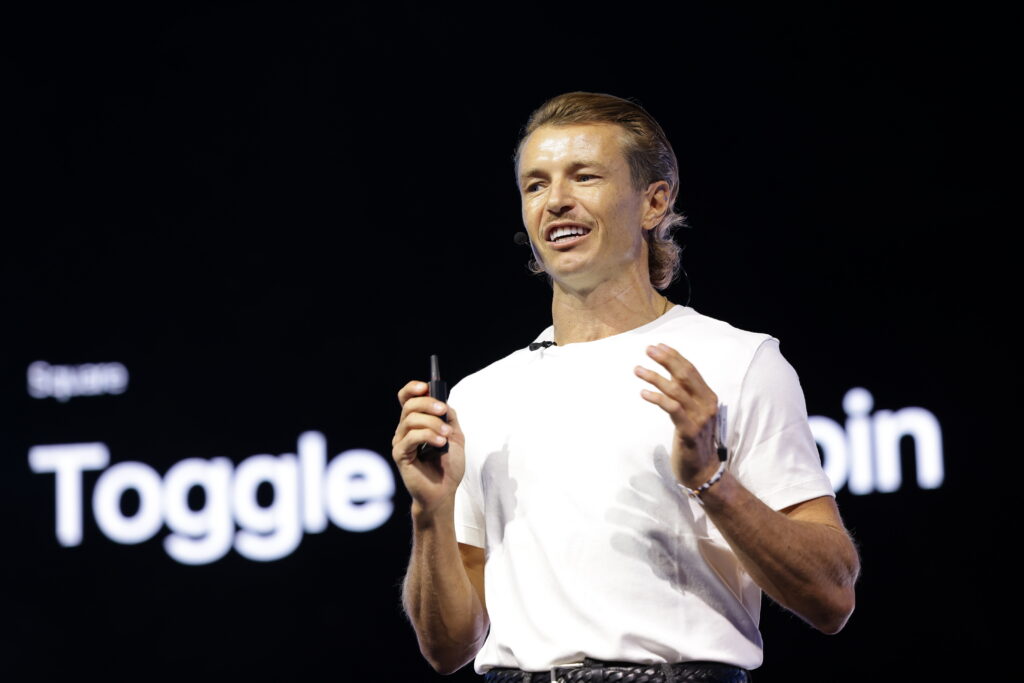
Block’s Bitcoin Product Lead Miles Suter took the Nakamoto Stage at Bitcoin 2026 in Las Vegas on Tuesday morning with a clear message: bitcoin must circulate, not just sit.
“If Bitcoin doesn’t work as a peer-to-peer currency, it loses the quality that makes it revolutionary,” Suter said, basing the entire Block product on the idea that Satoshi is building a network so that “the whole world can work on a free, fair financial system.”
The presentation came one day after Block released a wave of bitcoin-focused product announcements on April 27, making it one of the most aggressive products the company has made at a single conference.
Merchant acquisitions reach 800,000 – and rising
Suter cited live streaming as proof that the strategy is working. Block now has more than 800,000 Square businesses with bitcoin payments automatic registration enabled, and a new business activates the feature every eight seconds, he said on stage.
This figure builds on Block’s March 2026 decision to automatically enable bitcoin payments to eligible US Square merchants, a rollout that reached millions of merchants in one move. Suter also unveiled a bitcoin swipe-to-pay feature, saying Block is on track to make bitcoin payments at a point of sale as seamless as Apple Pay.
The system uses NFC and Lightning Network hardware for settlement, does not require QR codes, and carries zero cash processing by 2026.
Suter described a future revenue model: employees receive their paycheck in the Cash App, convert it to bitcoin, and then swipe those funds to protect themselves. That idea ties in directly with Block’s enhanced product stack announced Monday.
Cash App now offers automatic conversion of peer-to-peer payments to bitcoin, a Bitcoin Back program to reward 5% for Square merchants, and bitcoin withdrawal limits increased fivefold to $10,000 per day and $25,000 per week.
On the storage side, Block released a new Bitkey hardware wallet with a built-in touchscreen and 2-of-3 multisig architecture, removing the need for seed phrases and tying transaction verification to the device’s screen rather than an external system.
“Bitcoin only works if no one company controls it,” Suter said.
Proof of block of reserves: $2.2 Billion in BTC
Block also published its Q1 2026 Proof of Reserves on April 27, revealing a total of 28,355.05 BTC worth about $2.2 billion. Of that total, 19,357.16 BTC – about $1.5 billion – were customers, while the company’s treasurer held 8,997.89 BTC with an estimated value of $696 million. The palace’s dashboard uses on-chain cryptographic signatures for public authentication, and Block said the holdings show more effective control than historical snapshots.
The disclosure put Block among a growing list of firms taking steps to show transparency on the chain, although analysts noted that proof of bookings alone does not guarantee customer credit or obligations.
Suter’s panel, titled “Living on Bitcoin,” served as part of a broader conference theme pushing bitcoin into commercial use. The session dedicated to Bitcoin 2026 also promotes the exemption of the de minimis tax on small transactions of bitcoin – a policy that, if implemented, will remove the reporting burden of large profits that currently prevent daily use.
Jack Dorsey has publicly argued that bitcoin will fail as a technology if it doesn’t work as money, a position Suter held on stage Tuesday when he said Block’s goal is to make bitcoin “everyday money.”