Bitcoin fell below cost fundamentals during the May market correction: Finestel


Bitcoin closed May near $70,600 after losing about 8% to 10% during a month dominated by rising inflation, higher Treasury yields, and growing global uncertainty, according to a market report from Finestel.
Summary
- Finestel said Bitcoin ended May near $70,600 after inflation concerns, rising Treasury yields, and global tensions caused the market to pull back.
- The report found Bitcoin has fallen below the owner’s cost base levels, while support has emerged in the $70,000 to $73,000 range.
- Professional asset managers are increasing stablecoin allocations and reducing altcoin exposure as they adopt a defensive stance.
According to Finestel’s May market report shared with crypto.news, Bitcoin (BTC) entered the month with strong momentum and briefly rose to around $82,839 after breaking above the $79,500 resistance area.
Conditions changed after April inflation data came in higher than expected, prompting investors to revise expectations for interest rate cuts and reduce exposure to riskier assets.
Data cited by Finestel showed the CPI for April reached 3.8% while the PPI rose to 6.0%, both exceeding forecasts. The report said the minutes of the Federal Open Market Committee revealed a critical situation among policymakers, and expectations of rate cuts were pushed out under Federal Reserve Chairman Kevin Warsh.
At the same time, volatile developments surrounding the US-Iran talks add another layer of uncertainty. Finestel noted that Treasury yields rose significantly, with the 10-year yield reaching 4.66% and the 30-year yield rising to over 5.18%, which contributed to reducing risk in the financial markets.
By the end of May, Bitcoin had fallen to about $70,600 from a high of more than $82,800, while the total cryptocurrency market capitalization fell from about $3.05 trillion to $2.45 trillion, according to the report. Ethereum posted heavy losses, down 12% to 15% during the same period.
Bitcoin is under pressure from a significant cost base
One of the most important developments highlighted by Finestel was the movement of Bitcoin under the basis of short-term holder costs.
After failing to maintain momentum between $81,000 and $85,000, Bitcoin fell below the $78,200 to $78,300 area and fell below the market cost base of $78,277, according to the report. Finestel said this creates a number of investors holding positions at a loss, which increases the chances of selling pressure if prices return to the $75,000 to $78,000 range.
Support has now formed between $70,000 and $73,000, which Finestel has identified as a key area for market participants to monitor in June.
The report’s on-chain analysis suggested that short-term holders accounted for most of the recent selling activity, while long-term holders maintained their positions. The spot cumulative volume delta data also showed emerging profit buying during the decline in the $70,000 to $77,000 area.
Elsewhere, Bitcoin dominance has risen to more than 61% from around 58% in early May, indicating that capital is increasingly focused on Bitcoin while investors reduce exposure to high-risk assets.
Conditions worsened in early June. As previously reported by crypto.news, Bitcoin dropped below $63,000 amid renewed US-Iran tensions and more than $1.6 billion in crypto losses in a 24-hour period. Several market analysts have identified the $55,000 to $50,000 region as a potential downside if selling pressure continues.
Asset managers maximize cash and reduce risk
Despite the market decline, Finestel’s AUM-weighted tracking of professional asset managers showed a moderate response rather than widespread liquidation.
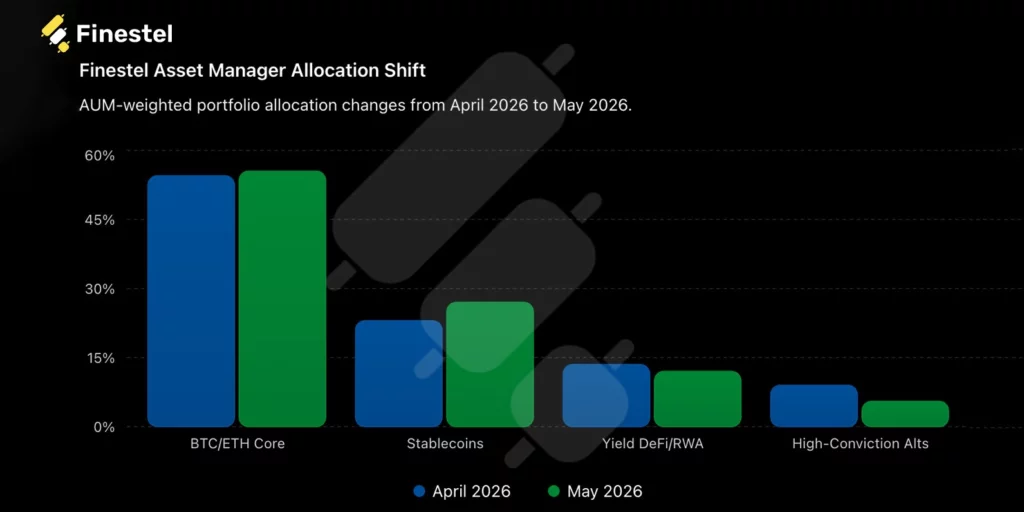
At the end of May, the shares of Bitcoin and Ethereum rose modestly to 55.5% from 54.5%, according to the report. Stablecoin Holdings rose significantly, rising from 23% to 27% as management increased the holdings.
Exposure to yield-generating DeFi and real-world asset strategies fell from 13.5% to 12%, while allocation to high-risk altcoins fell from 9% to 5.5%, the report showed. Leverage is also declining as firms move toward more structured positions.
The report said many managers began reducing risk in mid-May, using periods of strength to increase cash positions while maintaining underlying Bitcoin and Ethereum exposure.
Looking ahead, the company recommends keeping portfolios 55% to 57% in Bitcoin and Ethereum, holding 26% to 28% in stablecoins, allocating 12% to 13% to provide focused DeFi and real-world asset opportunities, and limiting high-trust altcoin exposure to between 5% and 7% exposure.
According to Finestel, a sustained recovery may require Bitcoin to regain the $78,000 level and an improvement in macroeconomic conditions.
Until then, the report said that holding funds and maintaining cash remains the preferred option as markets continue to react to inflation data, interest rate expectations, and national developments.
Disclosure: This content is provided by a third party. Neither crypto.news nor the author of this article endorses any product mentioned on this page. Users should do their own research before taking any action related to the company.