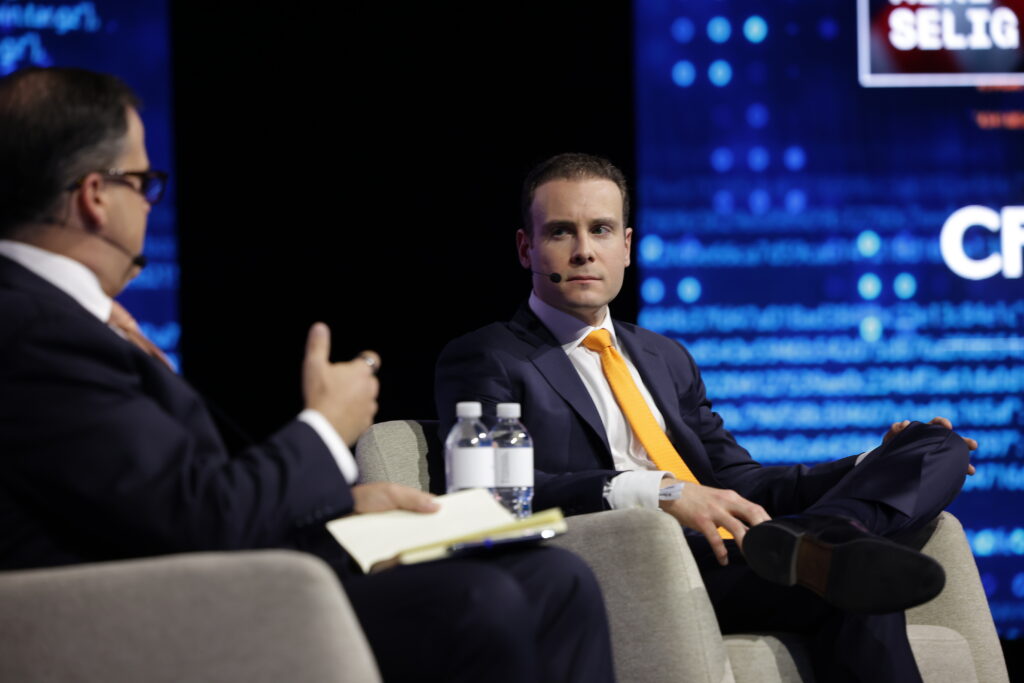
SEC Chairman Paul Atkins and CFTC Chairman Mike Selig used back-to-back discussions on the Nakamoto Stage at The Bitcoin 2026 Conference to show how to reset Washington’s approach to digital assets, tokens, and market structure.
Atkins described it as “a new day for the SEC,” while Selig said regulators are “turning a new page” and need to align their efforts.
Atkins said the SEC is taking a new approach to digital assets and wants that activity to be in the water rather than being pushed into foreign jurisdictions. He said the SEC and CFTC are now working together on digital assets and aim to set a new benchmark for inter-agency cooperation.
That collaboration supports the guidance for a shared token taxonomy, which draws the lines between digital assets, collectibles, and tokenized securities and provides market participants with a framework they can use as they categorize assets.
Atkins revisited the long-running debate over how the Howey test and existing securities laws apply to crypto. Atkins said the SEC is trying to apply that framework to digital assets, tokens, and related instruments while grappling with the boundary between securities and commodities.
Atkins: “Release in a new version” is coming
He pointed out that “innovative exemptions” are coming, designed to give crypto projects room to build within the established regulatory framework instead of staying in a gray area or going offshore.
Atkins tied that effort to Congress and said legislators need to talk clearly about digital assets so that there are strong laws and businesses can pursue their goals in the United States.
He stated that it is important to have a future proof law for this space and he did not say anything about the future proof of the market as a clear legal rule created with emerging technologies in mind. He pointed to the proposed taxonomy as a step in that direction but emphasized that legislation from Congress would strengthen the policy in all states.
In the latest directive, Atkins said the agencies want to provide principles and explanations without publishing a set list of tokens or suggesting recommendations about what investors should buy. He cited President Donald Trump’s GENIUS Act on stablecoins as an example of a principles-based regulatory model that leaves room for innovation while drawing strict boundaries around risk.
He said the SEC is focusing on tokenized securities on a principles-based basis rather than detailed product-by-product prescriptions.
Atkins also talked about the law of Clarity and the broader law of crypto market structure. He said there could be some movement in that package in May, possibly even through June, but cautioned that nothing is guaranteed.
If changes to the crypto structure do not pass, he said, industry participants should remember that elections have consequences, pointing to the pivots of both the SEC and CFTC as evidence of how quickly regulatory priorities can change.
Looking ahead, Atkins framed crypto and blockchain technology as the most exciting aspect of the current revolution. He emphasized the prospect of a quick settlement and said that a quick settlement would reduce risks in the financial system.
He said that faster or closer payments, can reduce the company’s risk and payment and free up money that is currently tied up in office processes. He said regulators are trying to encourage that outcome rather than stand in its way.
Atkins said “this is a new day at the SEC” and previewed the agency’s next step: a step that will allow firms to test the chain with tokenized and verified tools in the next few weeks.
Under that effort, companies will be able to test tokens in a regulated environment while staying within federal securities law. He included this as part of an upcoming release of innovation, which aims to open up the sandbox of tokenized securities under clear boundaries instead of being freed from informal inaction.
Selig: CFTC turns a new page in crypto
In his own time, Selig emphasized the essence of resetting control. He said the CFTC is “opening a new page” in its approach to digital assets and emphasized the need to harmonize the agency’s work with the SEC. In markets that trade in products that have both characteristics such as goods and defenses, he said, the two organizations need an integrated framework instead of overlapping or conflicting rules.
Selig also couched his words in broader terms, saying that “our country was founded on the idea of private property.” In the crypto world, that line emphasized his view that token holders and founders should have clear, legally enforceable rights.
He suggested that the structure of a compatible crypto market for digital assets should respect property rights and provide market participants with predictable rules, rather than operating in less regulated areas.