Startup’s nuclear-inspired cooling system can make data centers sustainable | MIT News

The growth of artificial intelligence is riding on the back of data center expansion. Data centers are expected to account for 9 to 17 percent of total US electricity consumption by the end of the decade. Today, about a third of data center electricity is dedicated to cooling chips that run AI models.
That’s the process Ferveret uses to make it work so well. The startup, founded by Reza Azizian, a former MIT postdoc in nuclear engineering, and Matteo Bucci, MIT’s Esther and Harold E. Edgerton Associate Professor in the Department of Nuclear Science and Engineering, is developing a path from nuclear reactors to cooling chips that use no water and very low electricity.
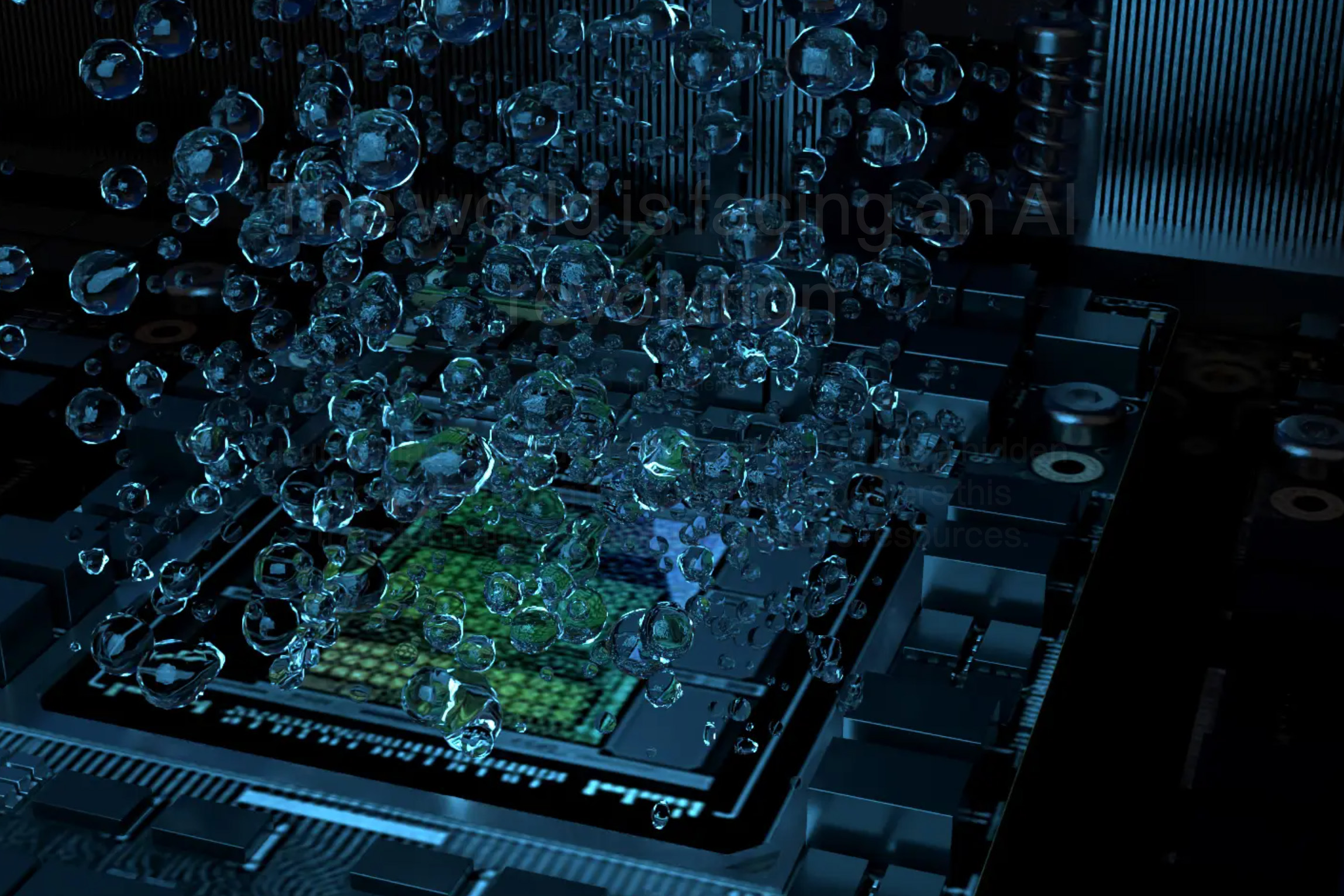
The company’s cooling system immerses computer servers in a special liquid that absorbs heat much better than air from a fan. What sets the solution apart from other liquid cooling systems are the bubbles: Ferveret’s Adaptive Phase Cooling (APC) solution produces very small bubbles on the surface of the server, which recede frequently, speeding up the heat transfer process.
Ferveret is already testing its solutions with companies including CleanSpark, a data center developer and operator, and FuriosaAI, an AI accelerator company, and Switch, one of the largest data center companies in the US.
In a recent study in collaboration with the Samuel Department of Computer Science at the University of California at Los Angeles, Ferveret found its APC solution resulted in a 15 percent improvement in computing power efficiency compared to modern liquid cooling solutions. By combining those savings with Ferveret’s power management system to optimize operating conditions, the company says it allows data centers to receive 35% tokens — small pieces of text or data — from their AI models with the same amount of power.
“Our goal is to make data centers as sustainable as possible and help them use every single watt of power to generate tokens, which are very useful results,” Azizian said. “Our system enables the operation of powerful chips, helps data centers waste less energy, and achieves all that with zero water consumption.”
From nuclear reactors to AI
Azizian was a postdoc at MIT in 2013 when he met Bucci, who was a research scientist at the time. They worked on heat transfer in nuclear reactors before Azizian moved into industry, where he focused on cooling chips. Azizian first worked on Microsoft’s HoloLens augmented reality headset and then joined Nvidia, which produces graphical processing units used by companies to train and run the latest AI models. Meanwhile, Bucci continued to conduct research at MIT, becoming an assistant professor in 2016.
Azizian moved into his first data center in 2017, where he was greeted by huge, loud fans who filled the building as they cooled down.
“I thought, ‘Creep, that’s not how you cool this place,'” Azizian recalls, noting that air cooling still takes up 40 percent of the energy going into a data center. “It wasn’t an efficient way to do things, but since it didn’t hurt performance, nobody cared that the cooling technology was 50 years old.”
Azizian began talking to Bucci about applying their knowledge about improving heat transfer in nuclear reactors to data centers. Scientists have spent decades finding better ways to transfer heat to nuclear reactors.
“Heat transfer determines how much power you can extract from the reactor core, which translates directly into revenue,” Azizian explained.
The founders started Ferveret in 2021. A lot has changed since Azizian moved into his first data center. Chip companies have packed more components into their chips as the explosion of artificial intelligence has put a premium on squeezing as much computing power as possible into limited power.
That has prompted data center operators to use liquid to cool the chips — usually through a technique known as immersion cooling that immerses the chips in liquid. The most effective method of immersion cooling is to bring the liquid to a boil.
“Liquids are a better way to transfer heat than air. That’s why if you put your hand in room temperature water it gets cold,” Bucci explained. “When the liquid boils, it’s even better at removing heat because the phase change requires more energy that you remove from the chip. That allows you to transfer more heat with less temperature difference between the chips and the liquid.”
Unfortunately, boiling liquids add complexity to the system because they force operators to capture and reduce bubbles while controlling pressure, temperature, and fluid volume.
The Ferveret system is based on a nuclear reactor process called cold boiling. It uses liquids with a low boiling point and none of the “toxic PFAS chemicals” that other methods rely on. On top of the chip, Ferveret liquid produces smaller bubbles than other immersion cooling methods. Those bubbles are more dispersed and coalesce faster in the surrounding liquid, speeding up the cycle of bubble rewetting on the chip surface to speed up heat transfer.
Ferveret delivers its APC system in small boxes, each with a single server. The founders say that their modular systems make it easy to distribute the system and simplify maintenance.
“Physics allows us to build features that weren’t possible in the past,” Azizian says. We have a small, rack-mounted solution that fits into the current infrastructure, so it’s easy for people to use our technology.”
Ferveret also provides control software that adjusts the power to each server in real time to improve efficiency.
“We deliver full-stack systems that include cooling boxes, racks, cooling distribution units, and sensors that measure temperature and pressure,” Bucci said. “Our software monitors those sensors and optimizes the operating conditions within each box to ensure that energy consumption is minimized in the system.”
AI with few resources
Besides helping data centers run more efficiently, Ferveret also improves sustainability by making it easier to run data centers in remote locations with renewable energy.
“The sun shines in places where you don’t have a lot of water, so our water-free advantage allows you to build data centers where you have solar power but nothing to cool the data center,” Bucci said. “This technology can help outsource data centers to places where you normally wouldn’t have the resources to do so, including Africa, the Middle East, and parts of the Americas. It’s a huge opening.”
Ferveret is in talks with large cloud computing companies known as hyperscalers, and is currently part of Nvidia’s Inception startup program. The company plans to announce an expanded partnership later this year. From there, the founders plan to rapidly scale their technology to help the AI industry continue to grow without depressing the planet.
“The computer industry is facing a big challenge in terms of getting power, and they are having trouble getting water in many regions,” said Azizian. “That will be limited as the industry grows. The primary goal of these data center operators will be to get more tokens out of the power they have. We’ve shown we can do that.”